
Video dominates digital marketing, but traditional videos are passive – people watch and scroll away. Interactive video turns that passive experience into active engagement, allowing viewers to click, decide, answer, explore, and take action without ever leaving the video.
For businesses, this means:
- Higher engagement
- More qualified leads
- Better product understanding
- Stronger conversions
- More ROI from videos
Studies show interactive videos can generate longer viewing times, stronger recall, and significantly higher click-through rates compared to standard video formats.
But here’s the challenge:
👉 Not all interactive video platforms are built the same
👉 Choosing the wrong one can waste months and budget
This guide will help you choose the right interactive video platform for your business.
What Is an Interactive Video Platform?
An interactive video platform is software that lets you create videos where viewers can:
- Click hotspots
- Choose different story paths
- Fill forms inside the video
- Answer quizzes
- Navigate chapters
- Buy products directly
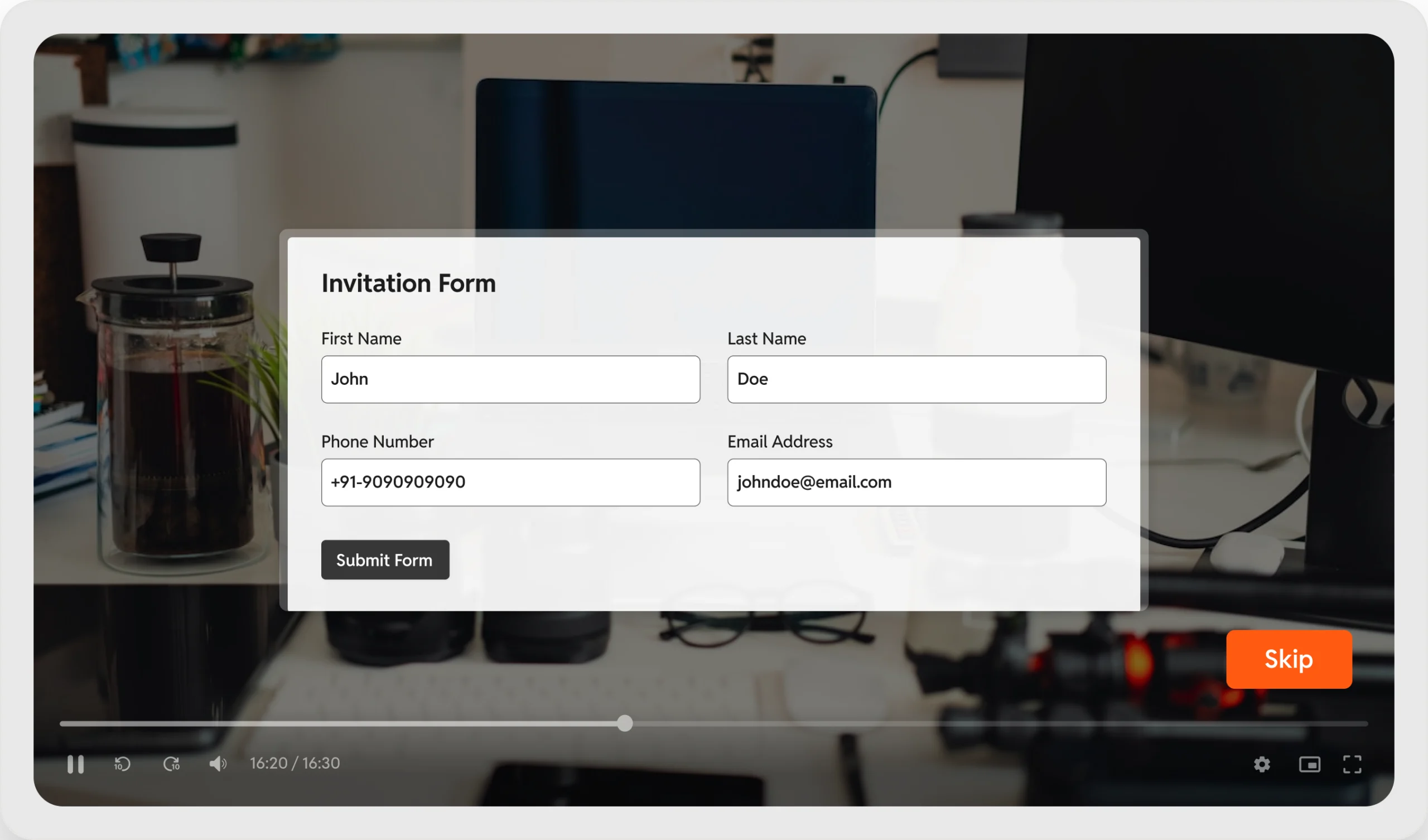
Unlike standard hosting platforms, interactive systems also provide detailed behavioral analytics, tracking what viewers click and how they engage.
This transforms video from a branding tool into a conversion engine.
How to Choose the Right Interactive Video Platform
Before choosing, verify these critical capabilities basis of:
Platform / CMS You Are Using
Before comparing features, first check whether the interactive video platform works smoothly with your existing website or tech stack.
For example, if your site runs on WordPress, Shopify, Webflow, or a custom CMS, the platform should offer:
- Native plugins or integrations
- Simple embed options
- Compatible video players
- Fast loading without breaking layouts
If the system doesn’t fit your CMS well, even the best features become frustrating to use. Teams often underestimate this and later face problems like broken embeds, slow loading, or developers needing to intervene for every update.
No-Code vs Low-Code (Evaluate Ease of Use)
Ease of use directly impacts how often your team will actually create interactive videos.
No-code platforms usually offer:
- Drag-and-drop editors
- Visual timeline interaction building
- Ready templates
- Simple publishing
Low-code platforms may provide more flexibility but often require:
- Technical setup
- Custom scripting
- Developer involvement
If your marketing team plans to create videos regularly, a no-code system is usually the better choice.
Business Goal
This is the most important determinant.
Different interactive video platforms are optimized for different outcomes.
Clarify your main goal first:
- Lead generation → Need in-video forms, email capture, email marketing tools, CRM sync
- Product marketing / eCommerce → Need clickable hotspots, product tagging, CTAs
- Training or onboarding → Need quizzes, progress tracking, video branching
- Customer engagement / storytelling → Need decision-based navigation and video chapter controls
Choosing a platform without defining your primary business goal usually leads to a feature mismatch and poor ROI.
Types of Interactivity Supported
Not all platforms offer the same level of interactivity.
Basic platforms may only allow:
- Clickable links
- Simple buttons
Advanced platforms should support:
- In-video forms
- Adding CTA inside videos
- Clickable hotspots on objects
- Video branching decision paths
- Quizzes and polls
- Timeline chapter navigation
- In-video forms
- AI Transcription
The richer the interaction options, the more use cases you can build – from product demos to guided sales videos to onboarding experiences.
Evaluate Analytics Depth

Interactive video generates much more data than standard video – but only if the platform tracks it properly.
Basic analytics typically include:
- Total views
- Watch time
- Completion rate
Strong interactive analytics should include:
- Click heatmaps
- Engagement rate
- Drop-off points
- Form conversion inside the video
- Geo data
- Performance comparison
Without deep analytics, you won’t know what is working or how to improve future videos and place interactive video elements.
Compare Pricing vs Long-Term Usage
Check if you get pushed to a higher price. Some platforms limit the number of videos, restrict how many users you can add and often lock highly useful interactive videos behind their enterprise plan.
Integration Capabilities
Integration determines whether your interactive video fits into your overall marketing and sales workflow. For example, if someone fills a form inside your video, that data should automatically reach your CRM or email system.
Final checklist: A Good Interactive Video Platform Should Have
- Easy editor (No code or low code)
- Multiple interaction types (Forms, CTAs, Polls etc.)
- Video analytics
- Fast global CDN video delivery
- Mobile-optimized playback
- CRM + marketing integrations
- Conversion tracking
On top of it, check for your specific business needs.
Why Businesses Are Switching to Interactive Video
Before choosing a platform, it is important to understand why companies are investing in this technology.
Much Higher Engagement
Interactive elements turn passive viewers into active participants, increasing watch time and completion rates.
Stronger Conversions
Clickable CTAs and in-video forms shorten the journey from interest to action. Some campaigns report dramatically improved conversion performance compared to standard videos.
Actionable User Data
By capturing user behavior, engagement metrics, and drop-off points, interactive platforms enable the development of a more robust, data-driven content strategy.
Measurable Revenue Growth
By incorporating interactive videos, businesses that already utilize video marketing can enhance visitor conversion rates without incurring significant extra costs, thereby boosting overall revenue.
Links: Interactive video layers | Integrations | Start for free
Leave a Reply